

Muhammad Yunus (Bangla: মুহাম্মদ ইউনুস, pronounced Muhammôd Iunus) (born 28 June 1940) is a Bangladeshi banker, economist and Nobel Peace Prize recipient. He previously
was a professor of economics where he developed the
concepts of microcredit and microfinance. These loans are
given to entrepreneurs too poor to qualify for traditional bank loans. Yunus is also the founder of Grameen Bank. In 2006, Yunus
and the bank were jointly awarded the Nobel Peace Prize, "for their efforts
to create economic and social development from below."[1] Yunus himself
has received several other national and international honors. He is the author
of Banker to
the Poor and a founding board member of Grameen America and Grameen
Foundation. In early 2007 Yunus showed interest in launching a political
party in Bangladesh named Nagorik Shakti (Citizen Power), but later discarded
the plan. He is one of the founding members of Global Elders. Yunus also
serves on the board of directors of the United Nations Foundation, a public
charity created in 1998 with entrepreneur and philanthropist Ted Turner’s historic $1 billion
gift to support United
Nations causes. The UN Foundation builds and implements public-private partnerships to
address the world’s most pressing problems, and broadens support for the UN.
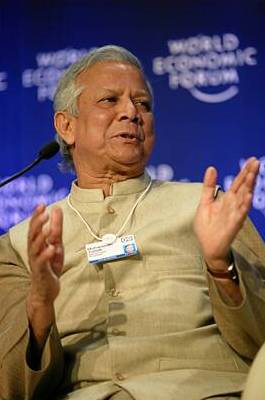
"Banker to the Poor"
Professor Muhammad Yunus established the Grameen Bank in Bangladeshin 1983, fueled by the belief that credit is a fundamental human right. Hisobjective was to help poor people escape from poverty by providing loans onterms suitable to them and by teaching them a few sound financial principlesso they could help themselves.
From Dr. Yunus' personal loan of small amounts of money to destitute basketweaversin Bangladesh in the mid-70s, the Grameen Bank has advancedto the forefront of a burgeoning world movement toward eradicating povertythrough microlending. Replicas of the Grameen Bank model operate inmore than 100 countries worldwide.
Born in 1940 in the seaport city of Chittagong, Professor Yunus studiedat Dhaka University in Bangladesh, then received a Fulbright scholarship tostudy economics at Vanderbilt University. He received his Ph.D. in economicsfrom Vanderbilt in 1969 and the following year became an assistant professorof economics at Middle Tennessee State University. Returning to Bangladesh,Yunus headed the economics department at Chittagong University.
From 1993 to 1995, Professor Yunus was a member of the InternationalAdvisory Group for the Fourth World Conference on Women, a post towhich he was appointed by the UN secretary general. He has served on theGlobal Commission of Women's Health, the Advisory Council for SustainableEconomic Development and the UN Expert Group on Women and Finance.
Professor Yunus is the recipient of numerous international awards for his ideas and endeavors, including the Mohamed Shabdeen Award for Science (1993), Sri Lanka; Humanitarian Award (1993), CARE, USA; World Food Prize (1994), World Food Prize Foundation, USA; lndependence Day Award (1987), Bangladesh's highest award; King Hussein Humanitarian Leadership Award (2000), King Hussien Foundation, Jordan; Volvo Environment Prize (2003), Volvo Environment Prize Foundation, Sweden; Nikkei Asia Prize for Regional Growth (2004), Nihon Keizai Shimbun, Japan; Franklin D. Roosevelt Freedom Award (2006), Roosevelt Institute of The Netherlands; and the Seoul Peace Prize (2006), Seoul Peace Prize Cultural Foundation, Seoul, Korea. He is a member of the board of the United Nations Foundation.


/image%2F1184907%2F20220327%2Fob_bacdb6_alamgir1.jpg)